
JNVST Class 6 2027: Best Practice Sets, Solved Papers and Preparation Strategy

Preparing for the Jawahar Navodaya Vidyalaya Selection Test (JNVST) takes more than reading a guide from cover to cover. Students also need to solve questions, understand their mistakes and practise completing a paper within the given time.
This is where practice sets and solved papers become useful. They help students apply what they have learnt and show which topics need more attention before the examination.
If you are looking for a JNV Class 6 practice set book 2027, choose one that follows the latest syllabus and includes questions from all the required sections. For the 2027 admission cycle, students should pay particular attention to Environmental Studies (EVS), which is included in the revised examination pattern.
This guide explains how to use JNVST practice papers 2027, how solved papers can support preparation, what to look for in a JNV mock test book and how to build a practical study routine. It also introduces relevant practice resources available from Radian Books.
JNVST Class 6 2027: Important Exam Details
The Jawahar Navodaya Vidyalaya Selection Test is conducted by Navodaya Vidyalaya Samiti (NVS) for admission to Class 6 in Jawahar Navodaya Vidyalayas.
The 2027 admission cycle is for the 2027–28 academic session. According to the published prospectus, the examination is scheduled for 28 November 2026.
|
Exam detail |
Information |
|
Examination |
Jawahar Navodaya Vidyalaya Selection Test (JNVST) |
|
Admission class |
Class 6 |
|
Academic session |
2027–28 |
|
Conducting body |
Navodaya Vidyalaya Samiti |
|
Scheduled examination date |
28 November 2026 |
|
Examination mode |
Offline, OMR-based |
|
Total questions |
80 |
|
Total marks |
100 |
|
Duration |
2 hours |
|
Sections |
Mental Ability, EVS, Arithmetic and Language |
Students should check the official NVS admission portal for any subsequent announcements, examination instructions or changes to the published schedule.
JNVST Class 6 Exam Pattern 2027
Before attempting mock tests, understand the question distribution and time available for each component of the examination.
The published JNVST 2027 pattern includes four sections, with 20 questions carrying 25 marks in each section.
|
Section |
Questions |
Marks |
Time allocation |
|
Mental Ability Test (MAT) |
20 |
25 |
Combined 60 minutes with EVS |
|
Environmental Studies (EVS) |
20 |
25 |
Combined 60 minutes with MAT |
|
Arithmetic Test |
20 |
25 |
30 minutes |
|
Language Test |
20 |
25 |
30 minutes |
|
Total |
80 |
100 |
120 minutes |
Each correct answer carries 1.25 marks, and there is no negative marking under the published pattern. In addition, the 60-minute allocation applies to MAT and EVS together.
The prospectus includes the minimum qualifying marks, and students should consult the official document for the exact requirements and all instructions.
The 2027 pattern is an important consideration when selecting a JNV Class 6 practice set book 2027, as older practice books may contain a different question distribution. Check whether the content includes EVS and aligns with the current pattern.
Why Are Practice Sets Important for JNVST?
A student might understand something while studying, but struggle when questions are placed together in a test.
1. They demonstrate what you have understood
After studying a topic, answer related questions to check your ability to use the method independently. If you keep making the same mistake, you know what to revise.
2. They help students manage time
Completing a timed paper gives the opportunity to see how fast the student can solve questions of various types. With regular practice, the student can learn how to avoid spending too long on a difficult question.
3. They can highlight weaknesses
One might find it easiest in Arithmetic but struggle with figure-based reasoning. Another might find it easy to answer reasoning questions but needs more reading practice. Practice sets are a good way to highlight these gaps.
4. They build familiarity with the exam format
Solving questions in the format of an exam helps students to become familiar with the instructions, question numbering and answer choices. Practicing OMR is also an advantage because JNVST is an offline exam.
5. They provide organised revision
Instead of studying each chapter in order, you can use your test results to decide what to revise. The most valuable benefit of a test comes after you’ve completed it: reviewing the questions and learning what to revise. Simply completing one paper after another will not be as useful if the student doesn't understand why answers were incorrect.
Best JNV Class 6 Practice Set Books for 2027
The right book to choose depends on the student's language, level of preparation and need for revision. A student who has yet to learn the syllabus might need a complete guide before attempting practice sets. Someone who has studied most of their topics can use practice sets to track their progress.
Radian Books offers a selection of JNV Class 6 practice resources in multiple language editions. Here are some options to compare.
1. JNV Class 6 Practice Set Book 2027 – English Medium
This book is intended for students who prefer to practise in English.
View JNV Class 6 Practice Set Book 2027 – English Medium
The product listing describes 30 practice sets and a solved paper. Students can use this type of resource to practice questions, review answers and familiarise themselves with exam-style tests.
Before selecting this as their main practice resource, check the product page and contents to confirm the coverage of all four sections, including EVS.
2. JNV Class 6 Practice Set Book 2027 – Hindi Medium
Students who prefer to study in Hindi could consider the Hindi-medium edition.
View JNV Class 6 Practice Set Book 2027 – Hindi Medium
The product listing specifies 30 practice sets, a solved 2026 paper and coverage of Mental Ability, EVS, Arithmetic and Language. This makes it a good resource for regular practice and revision.
Students should attempt each set individually before checking the solutions. This allows them to see what they can solve without assistance.
3. JNV Class 6 Practice Set Book 2027 – Bengali Medium
Students who are preparing in Bengali can compare the Bengali-medium edition.
View JNV Class 6 Practice Set Book 2027 – Bengali Medium
The listing describes 30 practice sets and a solved paper, with practice covering Mental Ability, EVS, Arithmetic and Language. Check the product page for current stock and language details before ordering.
4. JNV Class 6 Practice Set Book 2027 – Marathi Medium
Students who need Marathi-medium material can explore this edition.
View JNV Class 6 Practice Set Book 2027 – Marathi Medium
The listing describes 30 practice sets, a solved paper and coverage of the main JNVST Class 6 sections. It can be used for regular practice after students have studied the relevant concepts.
Compare all available JNV books
To compare practice sets, guides and other study material in one place, visit the Radian Books Jawahar Navodaya Vidyalaya Exam Books collection.
Check the edition, language, table of contents and availability before selecting a book. The collection might include books for different classes, so it is important to select a resource intended for Class 6 preparation.
How to Use Navodaya Solved Papers Class 6
Solved papers are most useful when students make an effort to answer the questions before checking the solutions. Reading answers without attempting the questions can create false confidence.
Use the following method.
Step 1: Attempt the paper independently
Choose an appropriate paper and complete the questions without looking up the answer key. If practising under time constraints, adhere to the timings given in the official examination pattern for each section.
Step 2: Check every answer
Compare your answers with the answer key or solutions. Mark all incorrect answers and questions that you guessed correctly but couldn't explain.
Step 3: Understanding the mistake
Try to identify the reason for each error. Did you misunderstand the question, forget a concept, make a calculation mistake or overlook a detail in a figure?
Step 4: Revise the related topic
Return to the relevant section and solve a few similar questions before progressing to another practice paper.
Step 5: Attempt similar questions again
Revisiting similar questions after revision is a good way to test whether the student understands the method. You should be able to solve a similar problem without referring to your previous answer.
Step 6: Track your progress
Maintain a simple record of practice scores and recurring mistakes. Look out for improvements in accuracy and time management rather than basing your judgement on a single test.
Previous-year papers can help students understand question styles, but older papers may contain a different pattern. Use them together with material that covers the current syllabus.
JNV Mock Test Book: What Should You Look For?
Not every book labelled as a mock test or practice set provides the same kind of preparation. Before purchasing a JNV mock test book, check the following points.
Coverage of all sections: For the published 2027 pattern, look for Mental Ability, EVS, Arithmetic and Language.
Clear answer keys: Students should be able to check their answers without confusion.
Worked solutions: Explanations help students learn from mistakes rather than simply memorising the correct option.
Suitable language: The questions and instructions should be easy for the student to understand.
Practice in the current format: Check whether the book reflects the published question distribution and timing.
Enough room for revision: A useful book should allow repeated practice of the topics rather than a single attempt at each topic.
A solved paper: A previous-year solved paper can help students become familiar with the style of questions, provided they remember that older papers may not match every detail of the revised pattern.
A book does not need to be the thickest or contain the most questions to be useful. Clear explanations and regular review often matter more than the number of pages.
Subject-wise Strategy for JNVST Practice Papers 2027
A good practice plan allows attention to each of the four sections. Students should first understand the topics, and use practice questions to check their progress.
1. Mental Ability Test
Mental Ability questions test observation, pattern recognition and reasoning. Students should practice different figure-based question types that they find easy instead of repeating the ones that they find difficult.
During practice:
• Look closely at the relationship between figures.
• Check for changes in direction, shape, position or sequence.
• Eliminate options that do not follow the same rule.
• Review questions that took too long to solve.
• Re-try difficult questions after you have revised the method.
Accuracy should come before speed. Speed will improve as you become accustomed to the question types.
2. Environmental Studies
EVS is included in the published JNVST 2027 pattern, so students should make time for it when choosing and using practice papers.
Students should prepare according to the topics listed in the official prospectus, as the published syllabus covers areas related to the natural world, the human body, everyday science and the environment, and social surroundings.
For better revision:
• Study one topic at a time.
• Make short notes of facts and concepts.
• Practice questions after completing each topic.
• Revisit facts that are easy to confuse.
• Use the results of practice sets to identify gaps.
Do not assume that a practice book based on an older pattern contains EVS. Check its contents before relying on it for complete preparation.
3. Arithmetic Test
Arithmetic requires a combination of understanding and careful calculation. Students should learn the syllabus before full-length tests.
An effective practice exercise is to solve questions step by step, check the calculation and attempt a similar question alone. If the same mistake reoccurs, revise the concept instead of memorizing the answer.
When checking a practice paper, identify the concept error and calculation error. These require different types of revisions.
4. Language Test
The Language Test focuses on reading comprehension. Students should practice reading passages thoroughly and answering questions based on the content.
Useful habits include:
• Reading the whole passage before answering.
• Identify the main idea.
• Look back at the passage to confirm details.
• Understand the meaning of words from context.
• Avoid answers that sound reasonable but are not supported by the text.
Practicing reading regularly can help students be more familiar with passages and avoid careless mistakes.
A Practical Preparation Strategy for JNVST 2027
Students do not need to complete every practice paper in a rush. A structured routine that includes study, practice and revision is easier to manage.
Phase 1: Understand the syllabus
Start by reading the official syllabus and ticking off the topics. Highlight the topics that have been studied and those that need attention.
Phase 2: Learn the concepts
Use a suitable guide or school textbook to study each topic. Solve a few questions after every lesson to test your understanding.
Phase 3: Begin topic-wise practice
Once a topic is clear, solve related questions from the practice book. Check the answers and revise mistakes before proceeding.
Phase 4: Start full practice sets
Now that all the important topics have been revised, start attempting complete practice sets. Follow the instructions for the examination and practice marking answers on an OMR sheet.
Phase 5: Review and revise
Use the test results to highlight weak areas. Revise these topics and attempt another paper to check if your accuracy has improved.
Phase 6: Use the final days carefully
As the examination draws near, focus on revision and become familiar with common mistakes and question types. Do not change your whole preparation regime or study multiple books at the same time.
Common Mistakes Students Should Avoid
Looking at the answers before attempting: Attempt the questions first and refer to the solutions provided at the end.
Taking tests without revising: Use the results of the tests to identify weak areas.
Ignoring EVS: The revised pattern includes EVS, so check whether the practice material includes it.
Using only old papers: Older papers can provide good practice but may not follow the current pattern completely.
Focusing only on the score: Remember to look at the kind of mistakes you are making.
Changing books too frequently: Finish using the useful material in your main book before switching to another.
Skipping OMR practice: Practising marking answers carefully and double-checking the question numbers is essential.
Final Thoughts
Practice sets and solved papers can make the preparation process for JNVST more organised, but it is what the student makes of them that can decide the results. Learn the concepts, attempt questions independently, review mistakes, and revise topics before moving on to another paper.
If you are looking for a JNV Class 6 practice set book 2027, compare the language editions available and ensure that the contents match the syllabus. Use the practice papers to review your progress.
Explore the Radian Books Jawahar Navodaya Vidyalaya Exam Books collection to compare practice sets and other study materials for preparing for Class 6.
Frequently Asked Questions
1. Which is the best JNV Class 6 practice set book 2027?
Choose a book that follows the current syllabus and includes all four sections with clear answers or worked solutions. Select the language edition the student can understand easily.
2. How many practice sets should a student solve before JNVST?
There is no magic number of papers to solve for admission to Navodaya Vidyalaya. Students need to solve enough papers to familiarise themselves with the question format, identify weak areas, and manage time. Revision is as important as solving a paper.
3. Are Navodaya solved papers for Class 6 useful?
Yes. Solved papers can help students understand the question styles and learn how to solve questions. Students should attempt the questions first before referring to the solutions. Remember that older papers might be different.
4. Does the JNVST 2027 pattern include EVS?
Yes. The published 2027 pattern includes 20 EVS questions carrying 25 marks. Students should check that their practice book includes EVS.
5. Can students use a mock test book without a separate guide?
Students who already understand the syllabus may use practice sets to review their preparation. Students who are still learning the concepts may benefit from a guide or school textbook along with a practice book.
6. Where can I find JNVST practice papers 2027?
Students can explore the Radian Books JNV entrance exam collection for practice-set books and other preparation materials. Always check the edition, language, and sections covered before ordering.
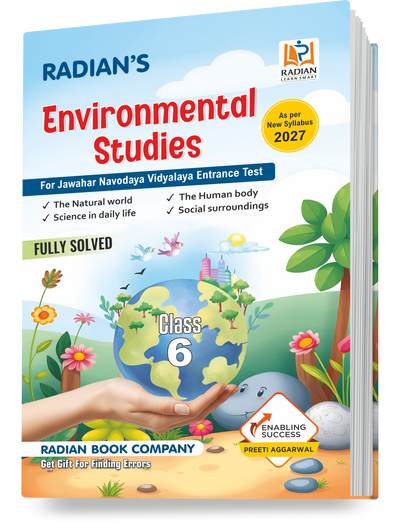
Environmental Studies (EVS) Book for JNVST Class 6 Entrance Exam 2027 | Fully Solved | English Medium
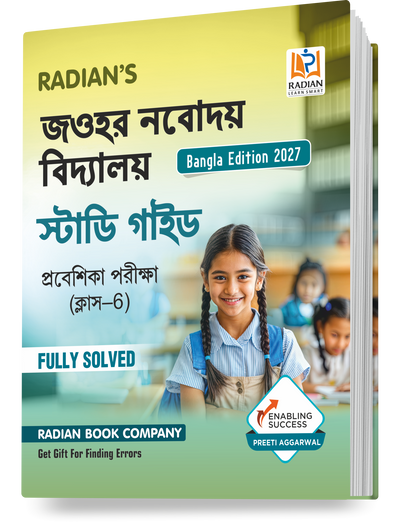
Jawahar Navodaya Vidyalaya Class 6 Entrance Exam Guide Book 2027 (Bengali Medium)

Jawahar Navodaya Vidyalaya Class 6 Entrance Exam Guide Book 2027 (English Medium)
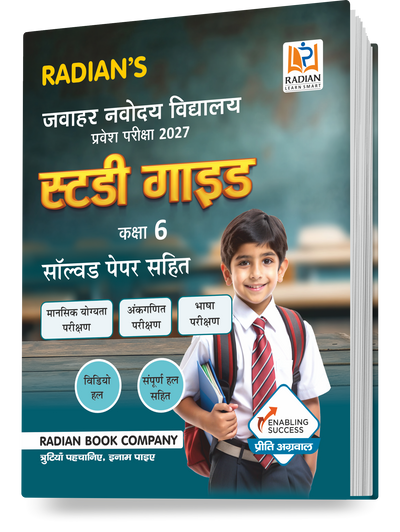
Jawahar Navodaya Vidyalaya Class 6 Entrance Exam Guide Book 2027 (Hindi Medium)

JNV Class 6 EVS Book 2027 Marathi | Fully Solved
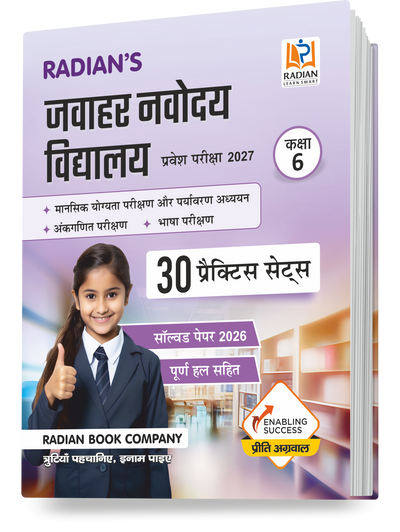
JNV Class 6 Practice Set 2027 Hindi | Based on Latest Updated Syllabus
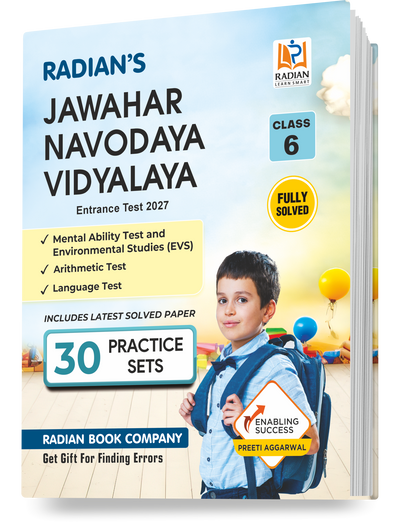
JNV Class 6 Practice Set Book 2027 (English) | 30 Practice Sets & Solved Paper
