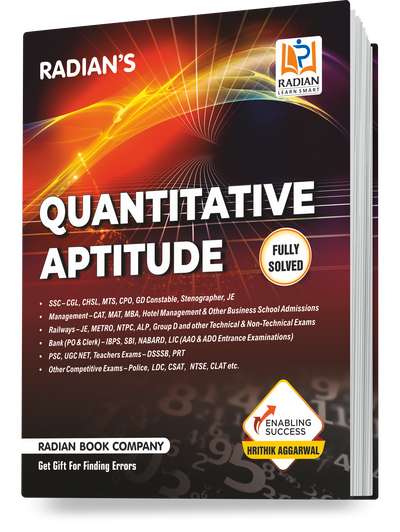
Best Quantitative Aptitude Books for Competitive Exams: Topic-Wise Weightage, Formulas and Maths Books by Level

Maths isn’t a tough subject for many candidates sitting for competitive exams. However, the difficulty lies in understanding which method to apply to solve, completing the problem within the time frame and calculating without making any minor mistakes. For example, percentage questions can be solved quickly once the concept is understood. However, time and work questions can get confusing if you aren’t confident in your basics.
Finding a good math book can help you. You should look for one that clearly explains the concepts, has worked examples, exercises with a variety of questions and introduces problems from easy to harder ones depending on the level. It should also match the exam you’re studying for.
In this article we’ll look at the key topics in maths and how you can understand their importance, which formulas to regularly revise and which book may work best for you.
First, Understanding the Topics in Quantitative Aptitude
While the topics will vary slightly depending on the exam, the following topics tend to be covered in Recruitment Exams by the SSC, Banking Organisations, Railway Recruitment Bodies and State level Commissions.
Key topics will generally be:
- Arithmetic: Percentage, Ratios and Proportions, Average, Profit and Loss, Discount, Interest, Partnership, Mixtures and Alligations.
- Number-based topics: Number System, Simplification, Fractions, Decimals, HCF and LCM.
- Time and Work: Time and Work, Pipes and Cisterns, Time speed distance, Trains and Boats and Streams.
- Algebra: Basic Identities, Equations and Surds.
- Geometry and Mensuration: Lines, Angles, Triangles, Circles, Quadrilaterals, Area and Volume.
- Data Interpretation: Tables, Bar Charts, Pie Charts and other Data.
- Advanced topics: Trigonometry, Probability and Permutation and Combination.
Before purchasing a book look at what topics are covered and compare them with the latest syllabus for your target exam. This can be found on the official SSC Website. If you’re taking an exam for a Banking role look at the relevant notification on the IBPS website.
Topic- Weightage: What Should You Study First?
A common question student ask is how many questions will be asked from percentage, algebra and geometry. The answer to this is that there is no fixed weightage per topic.
Sometimes the exam board may state how many questions will be asked from a section and how many marks but won’t guarantee how many questions will be asked from each chapter. For example, the SSC CGL 2026 notice states that there will be 25 questions in total for the Quantitative Aptitude section in Tier-I worth 50 marks. However, the topics are listed but there isn’t a guarantee for how many questions will be asked from each math topic.
The table below can help you decide which topics to focus on.
|
Topic group |
What to prepare |
Suggested priority |
|
Arithmetic |
Percentage, ratio, average, profit and loss, interest |
High |
|
Time-based problems |
Time and work, speed and distance, trains |
High |
|
Number system |
Divisibility, fractions, simplification, HCF and LCM |
High |
|
Data interpretation |
Tables, graphs and charts |
High for exams that emphasise DI |
|
Algebra |
Identities, equations and surds |
Medium to high |
|
Geometry and mensuration |
Triangles, circles, area and volume |
Depends on exam |
|
Trigonometry |
Ratios, identities and heights and distances |
Depends on exam |
|
Probability and counting |
Probability, permutation and combination |
Check the specific syllabus |
A good way to use this table is start with the topics in your exam syllabus. Once you’ve done that look at past papers. If you’re making mistakes with a certain topic repeatedly, try doing extra practice even if it’s not your highest scoring topic.
Top Maths Formulas to Include in Your Notes
Don’t try to learn all the formulas straight away. Understand the concept and try a few examples. Then note down the formulas you’ll need to use.
Some helpful formulas to note down:
Percentage
- Percentage = (Part ÷ Whole) × 100
- New value after an increase = Original value × (1 + Rate/100)
- New value after a decrease = Original value × (1 − Rate/100)
Average
- Average = Sum of observations ÷ Number of observations
- Total sum = Average × Number of observations
Profit, loss and discount
- Profit = Selling Price − Cost Price
- Loss = Cost Price − Selling Price
- Profit percentage = (Profit ÷ Cost Price) × 100
- Discount = Marked Price − Selling Price
Simple and compound interest
- Simple Interest = (Principal × Rate × Time) ÷ 100
- Compound Amount = (P(1 + R/100)T)
- Compound Interest = Amount − Principal
Speed, distance and time
- Speed = Distance ÷ Time
- Distance = Speed × Time
- Time = Distance ÷ Speed
Time and work
- If a person completes a task in (x) days, one day's work is (1/x).
- Combined work rates are added when people work together at the same time.
Geometry and mensuration
- Area of a rectangle = Length × Breadth
- Area of a triangle = ½ × Base × Height
- Area of a circle = (A = π r2)
- Circumference of a circle = (2πr)
Keep your notes brief and organised by chapter. Most importantly practice questions that require you to determine which formula to use. This is where you’ll see improvements.
Choosing the Right Maths Book for Your Level
The book that would work well for an advanced candidate may be challenging if you haven’t done any maths in years. Consider what level you’re currently at.
1. Beginner:
If you struggle with fractions, percentages, multiplication or basic equations look for a book with topics explained from scratch.
Look for:
· Clear theory in easy to understand language.
· Worked examples.
· Step-by-step methods.
· Easy to Moderate questions.
Try to avoid advanced practice papers. These can help later on but shouldn’t be used to understand the basics.
2. Intermediate:
If you understand most of the topics but are struggling to complete questions quickly look for a book with topic based practice and a variety of questions.
Practice percentage, ratio, average, profit & loss, time & work and data interpretation regularly. Don’t try to use shortcuts until you understand the standard method. Shortcuts can help if you understand why you’re using them and when.
3. Advanced:
If you’ve covered the syllabus look for books with mixed practice, past papers, timed practice and topics that still impact your score.
A good advanced book should have problems that require more thinking than just applying a formula. This can help you understand different methods, how long to spend calculating and when not to attempt a question.
Recommended Book for Structured Quantitative Aptitude
If you want a book that covers a wide range of math topics for Recruitment Exams then consider using the quantitative aptitude for competitive examinations by Radian Books.
This English Paperback book written by Hrithik Aggarwal has 816 pages. As stated in the product description this book contains topics such as: Number System, Simplification, HCF & LCM, Percentage, Average, Profit & Loss, Interest, Ratios & Proportion, Time & Work, Time & Distance, Algebra, Geometry, Mensuration, Trigonometry, Data Interpretation, Probability, Permutation & Combination.
This book has easy to understand theory, worked examples, practice questions and shortcuts where relevant. It states this book can be used for SSC, Banking, Railway, Defence, Insurance, State and Other Competitive Exams.
This could be a good book for beginners wanting to develop their concepts. It could also be useful for those needing to revise multiple topics. Make sure to check the product page to see if this book will fit your needs.
How to Get the Most from Your Maths Book
Once you’ve got a good book you can use the following steps to help you complete the syllabus.
- Pick one chapter: Pick a topic from your exam.
- Understand the method: Read the theory and worked examples.
- Attempt the questions: Try the practice questions.
- Note down mistakes: Did you make any mistakes with formulas? Calculation? Or did you misunderstand?
- Regular revision: Practice the tricky questions again after a few days.
- Timed practice: Once you’ve understood the basics try practicing under timed conditions.
Don’t just focus on how many questions you’ve completed. Focus on how many you’ve got correct and can you replicate the method.
Final Thoughts
The best quantitative aptitude book may not be the one with the most pages or questions. Look for a book that fits the exam syllabus you’re studying for, has clear explanations and provides plenty of relevant practice.
Start with your weakest topics and regularly use the formulas to help you revise. Check the latest official notice for your exam. Using a suitable book and regularly practicing will help you organise your maths revision.
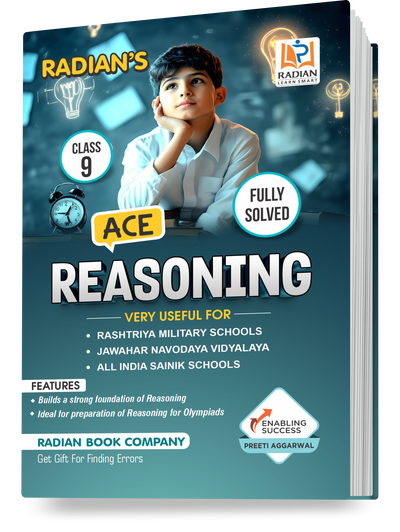
Ace Reasoning Book Class 9 | Entrance Exams 2026 Sainik School, JNV, RMS & Other Comptetive Exams
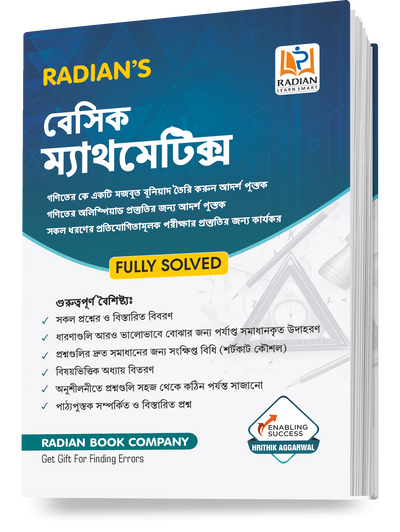
Basic Mathematics Guide Book 2026 | JNV, Sainik School, RMS & other Competitive Exams in Bengali

English Error Detection Fully Solved Book | SSC, Defence, Bank, Railways & Other Competitive Exams
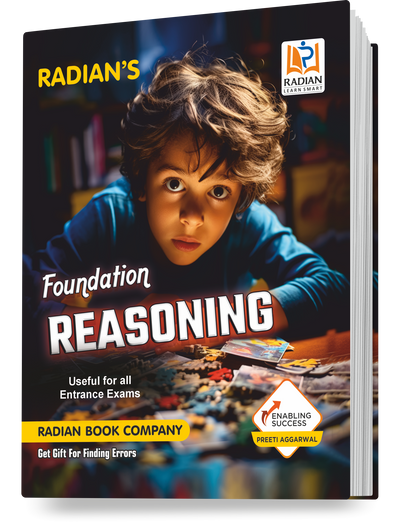
Foundation Reasoning Book for Class 3 & 4 (2026-27 Edition) | English Medium