Best Mathematics Books for Competitive Exams: How to Choose the Right Guide

Two students may study the same mathematics chapter, but score differently in a mock test. One understands the formula but takes extra time to solve the question, while the other completes it swiftly but makes minor calculation errors and loses marks. The reason behind their difference often lies in how they practice. A guide to choosing the best mathematics books for competitive exams.
Selecting a book to prepare for examinations such as SSC, Banking, Railway, Defence and other competitive examinations is an important decision. However, the most appropriate book to master mathematics is not the thickest with the most questions, but one that explains the concepts clearly, facilitates relevant practice and helps you identify which method to use.
Before buying any guide, consider which aspect of maths you need the most: strengthening your basics, additional arithmetic practice, advanced mathematics or a revision tool before the examination. Your decision will simplify your search.
Start With Your Exam, Not the Book Cover
Depending on the competitive examinations, the difficulty level of mathematics varies. Hence, a book suitable for SSC CGL may have advanced topics that you do not need for a particular recruitment test. On the other hand, a basic arithmetic guide may miss out on the topics you must learn for a higher-level examination.
Check the latest official syllabus of your target exam before making a purchase. For example, the Staff Selection Commission's CGL syllabus comprises number systems, percentages, ratio and proportion, averages, profit and loss, time and work, algebra, geometry, mensuration, trigonometry and other prescribed areas. The exact requirements are dependent on the examination tier and paper. You can visit the official SSC website and check for latest notices and syllabus details.
Create a short list of topics that you need to study, and compare it to a book's contents page before purchasing. This simple trick can save you from buying the wrong guide and missing out essential topics in your preparations.
1. Ensure Clear Explanations, Before Shortcuts
While short tricks may save time, they are not a replacement for understanding mathematics. Remember, if you memorise a method but do not understand it, you may not be able to apply it in front of an unfamiliar question.
A quantitative aptitude book suitable for self-study should introduce the concept before providing solved examples and questions for independent practice. Explanations should be simple to understand, especially for a chapter that comprises multiple steps.
For example, while learning percentages, you must understand how percentage changes work before solving questions related to discounts, profit and loss, etc. The same goes for ratio and proportion, averages and mixtures.
When evaluating a book for your needs, consider the following:
· Does it explain the basic concept in simple language?
· Are solved examples provided prior to your exercises?
· Are the examples explaining the steps clearly?
· Are shortcut methods explained, rather than just given?
· Can you practice the topic without another book explaining the basics?
If the answer to most of the questions above is yes, it is most likely a good guide for you to continue your self-study practice.
2. Check Whether Arithmetic Gets Enough Attention
Arithmetic comprises a substantial part of preparation for many competitive examinations. Sometimes, even understanding a question can slow you down on the day of the examination.
A good arithmetic practice book should cover the topics required by your target exam. Depending on the syllabus, these may include:
- Number systems, simplification, HCF and LCM,
- Percentages, averages and ratio and proportion
- Profit, loss and discount
- Simple and compound interest
- Time and work, including pipes and cisterns
- Time, speed and distance
- Mixture and alligation
- Partnership and related arithmetic problems
Do not base your decision only on the number of questions a book offers. While hundreds of repetitive questions may seem helpful, a small set with a clear explanation may be more valuable to you than a thick book with insufficient guidance.
Try doing a chapter's questions in stages - start without a time limit so you can understand the method. Once you can solve most questions, repeat a similar set with a timer. This way, you improve your speed, while learning about the topic.
3. Choose Advanced Mathematics Based on Your Exam
Some candidates focus on arithmetic and ignore algebra, geometry, mensuration and trigonometry until the final weeks. This may prove to be a problem if your target examination comprises these topics.
If your syllabus requires advanced mathematics, choose a competitive exam mathematics guide that covers the relevant concepts with diagrams, formulas and worked-out examples. Geometry questions, for instance, are easier to understand with labelled figures. In mensuration, you must know when to use each formula, rather than memorising a long list of them without practice.
Before purchasing, look for topics such as algebraic identities, equations, geometry, areas and volumes, trigonometric ratios and data interpretation, wherever applicable.
You do not have to revise every topic every day. You can start with the topics that challenge you, and revisit what you know through mixed exercises. Your official syllabus, as well as your performance in practice tests, should determine your priorities.
4. One Book Worth Considering: Radian Books Quantitative Aptitude
For candidates who want a single English-medium guide to cover a wide range of competitive-exam mathematics, one option to consider is the Quantitative Aptitude Book for All Competitive Exams from Radian Books.
The product page lists it as an 816-page page paperback written by Hrithik Aggarwal and intended for examinations including SSC, Banking, Railway, Defence, Insurance and various state-level recruitment tests.
Its listed coverage comprises number systems, simplification, percentages, averages, profit and loss, interest, ratio and proportion, time and work, time and distance, algebra, geometry, mensuration, trigonometry, data interpretation, probability and other quantitative aptitude topics.
The book is presented as a chapter-by-chapter guide with basic explanations, solved examples and practice exercises. The product description also lists previous-year questions and shortcut methods.
Who may find it useful? Beginners who want to approach concepts systematically and candidates who need a broad resource for revision may find this format convenient.
Before ordering, compare its contents with your examination's syllabus. A guide that covers multiple exams may have topics that you do not need, whereas a candidate preparing only for school mathematics may want a textbook designed for his class instead.
5. How to Know Whether a Maths Book Suits Your Level
A book can be comprehensive but still be a wrong choice for you. Try a few sample pages if available, before making a decision.
If you are a beginner, look for simple explanations and worked-out examples that start with the basics. If you understand the concepts, focus on topic-wise exercises, previous-year questions and a wide range of difficulty levels.
Also check the language, edition, answer explanations and publication. If the book does not explain its answers clearly, it may hinder your learning process of self-study.
6. Make Every Chapter Count
Buying the right guide is only one step. How you practice is an equally important aspect.
Select one topic and finish the basic explanation before attempting the exercises. Mark questions that you cannot solve independently, and revisit the relevant example before continuing. Keep a separate page for formulas and repeated mistakes.
At the end of the week, attempt a short-mixed test comprising the topics you studied. Review incorrect answers and those that you took too long to solve. This shows you what you need to revise, and whether you need to do more questions.
Avoid switching books whenever you get stuck with a question. First, try to understand the explanation in the guide that you have. Add another resource only when you can identify a specific gap, such as missing syllabus coverage, or insufficient practice.
Final Thoughts
The right mathematics book should help you move from understanding a concept to solving questions accurately by yourself. Check the syllabus, compare chapter coverage and choose a guide that suits your current level before giving yourself enough time to practice, revise and learn from your mistakes.
If you are looking for a broad quantitative aptitude resource to help you prepare in English, explore Radian Books Quantitative Aptitude guide and compare its contents before ordering. A well-chosen book that you use consistently is more valuable than a collection of resources that you rarely open.
Frequently Asked Questions
1. Which is the best mathematics book for competitive exams?
Choose a book that fits your exam syllabus, clearly explains concepts and provides solved examples with sufficient practice. The best option depends on your target examination and current preparation level.
2. What should a quantitative aptitude book include?
It should cover the topics prescribed for your exam, with explanations, solved examples and practice questions. Depending on the syllabus, this may include arithmetic, algebra, geometry, mensuration, trigonometry and data interpretation.
3. Is a separate arithmetic practice book necessary?
Not always. If your main guide contains enough well-explained arithmetic questions, you may not need another book. A separate practice resource can help if you need more exercises on specific topics.
4. Can beginners use the Radian Books Quantitative Aptitude guide?
The product page describes the book as suitable for beginners as well as candidates revising for competitive exams. Check its contents and sample material, if available, to ensure that the explanations are suitable for your learning needs.
5. How should I practise mathematics for competitive exams?
Learn the concept, solve examples, practice independently and review your mistakes. Once your accuracy rate improves, introduce timed sets and mixed-topic tests to improve your speed.
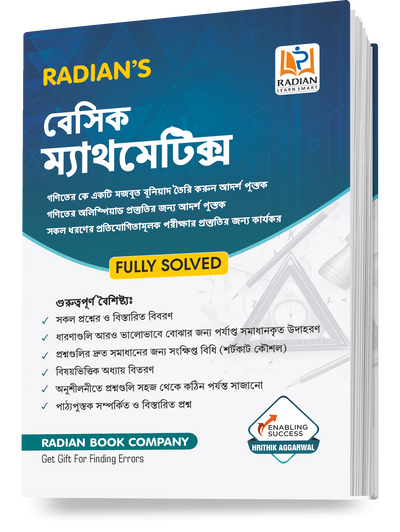
Basic Mathematics Guide Book 2026 | JNV, Sainik School, RMS & other Competitive Exams in Bengali
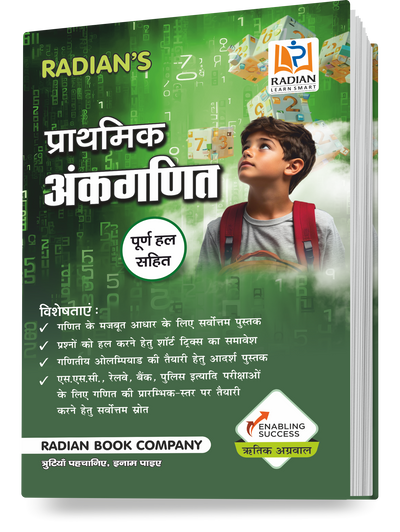
Prathmik Ankganit Basic Maths Guide All Entrance & Competitive Exams (Hindi) | 2025-2026
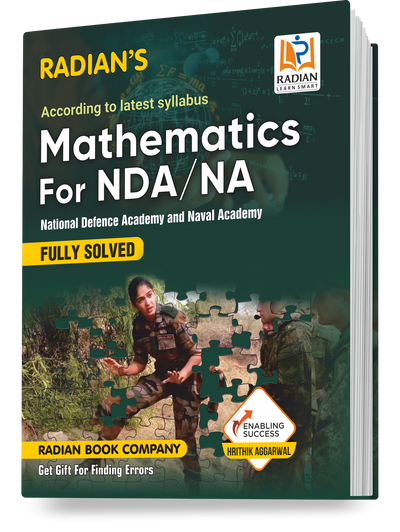
Mathematics Fully Solved Guide Book | NDA & NA Entarance Exam | 2023