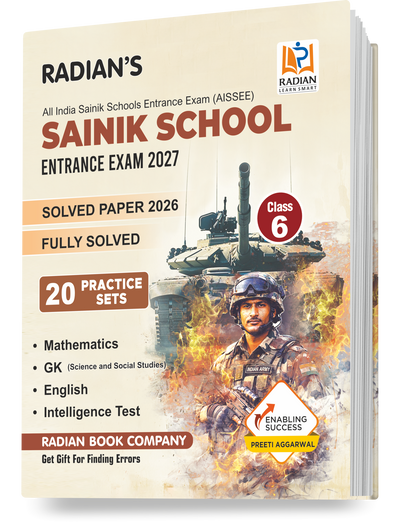
AISSEE 2027 Preparation Strategy for Class 6: Subject-Wise Study Plan

For a Class 5 student preparing for the Sainik School entrance exam feels like a task. There are four subjects to cover school homework to finish and many new questions to practice. Without a plan students may spend too much time on one subject and leave the others for later.
The solution is to start with the basics and follow a routine that fits into the school day. Students do not need to solve hundreds of questions. Students need to understand what they study practise regularly and learn from their mistakes.
This guide covers an AISSEE 2027 preparation strategy for Class 6 including subject‑wise tips, a daily timetable, book selection and mock test practice.
Understand the AISSEE Class 6 Exam Pattern
Before buying books or making a time table students should understand the examination pattern.
According to the available AISSEE Class 6 pattern the paper has four sections:
|
Subject |
Questions |
Marks |
|
Mathematics |
50 |
150 |
|
Language |
25 |
50 |
|
Intelligence |
25 |
50 |
|
General Knowledge |
25 |
50 |
|
Total |
125 |
300 |
Mathematics carries half of the marks so it needs regular attention. However students should not ignore the three subjects.
Important: These figures are based on the available pattern, not a confirmed AISSEE 2027 notification. Check the NTA AISSEE website for the 2027 information bulletin, syllabus and examination instructions before finalising your study plan.
1. Mathematics: Understand Before You Memorise
Mathematics is often the section where students need the practice. Some students can solve calculations but struggle when the same concept appears in a word problem. The best way to start is to focus on one area at a time
Depending on the syllabus this may involve fractions, decimals, LCM, HCF, ratio, and proportion, percentage, average, profit and loss, and geometry.
How to prepare: Read the concept and solve a few examples. Then, try the exercises without referring to the solutions. If a student gets stuck, they should think about the reason before directly moving to the solution.
For example, a student facing difficulty with fractions should revise how to perform operations before moving on to word problems.
Try doing 15-20 questions in each sitting, depending on the difficulty. Keep a notebook for all the formulas and mistakes and re-read them every weekend.
2. Language: Read, Practise and Revise
The Language section evaluates a student’s understanding of words, sentences, and passages. Students must verify the languages mentioned in the official AISSEE 2027 bulletin.
Regarding preparation, students must revise grammar, tenses, articles, prepositions, synonyms, antonyms, spelling, and reading comprehension, if mentioned.
How to prepare: Read a passage and answer the given questions. Learn new words and try to use them in sentences and for grammar, focus on one topic at a time.
A student making repeated errors with tenses, for example, should revise the relevant rules and practice a few exercises.
20-25 minutes of practice per day is a good start. Students preparing for the exam in Hindi or another language must use the relevant resources and check the official guidelines regarding eligibility.
3. Intelligence: Learn to Spot Patterns
The Intelligence section tests a student’s power of observation and logic. A student might understand how to arrive at the solution upon reviewing it, yet be unable to do so independently. With consistent practice, they can overcome this hurdle.
Possible topics: Number series, analogies, classifications, coding-decoding, directions, blood relations, and visual patterns, if mentioned in the syllabus.
How to prepare: It is best to focus on one type of question and understand the pattern before moving on to the next. For example, in a series of numbers, a student must try to determine the connection between the various numbers before selecting the right option. They should then practice questions on their own without assistance.
Spend 20-25 minutes on reasoning practice on a weekly basis. When a student gets a question wrong, they should write down the logic for the incorrect choice. After studying the different types of questions, students can test their aptitude with mixed reviews to see if they can identify patterns on their own.
4. General Knowledge: Small Sessions Work Better
General Knowledge can be difficult to revise at the minute because it covers many topics. Short daily sessions make it easier to remember information.
There are numerous topics to review for General Knowledge, making it challenging to prepare in a short amount of time.
How to prepare: Study for just 15-20 minutes per day. Pick a topic and read it, then close the book and try to recall the key details. On Sunday, students should review the topics they studied throughout the week.
For example, if they studied about rivers, they should practice questions about their origins, tributaries, and the states they run through. Students may study history, geography, national symbols, institutions, science, notable people, and more, depending on what’s on the syllabus. It is critical to use study material that is appropriate for their level and not attempt to memorize everything. Focusing on the information provided in the curriculum is recommended when preparing for the examination rather than attempting to retain all of the facts.
A Daily Study Timetable for AISSEE 2027
The time-table should be created keeping in mind the time needed for school and other commitments. Here’s an example for students with two hours to dedicate to preparing for the exams.
|
Subject or activity |
Time |
|
Mathematics |
40 minutes |
|
Language |
25 minutes |
|
Intelligence |
25 minutes |
|
General Knowledge |
15 minutes |
|
Revision and mistake review |
15 minutes |
|
Total |
2 hours |
It is advised to leave out other tasks so that students can concentrate on the four areas. Students who need assistance with Mathematics can spend more time on it, whereas others can allocate the extra time to their weaker area.
It is more crucial to return to the daily practice than to compensate for the lost hours.
How to Plan Preparation Before the Exam
Divide your preparation into three phases
First finish basics. to avoid getting overwhelmed by attempting to prepare everything at once. First, get comfortable with the fundamentals. Understand the syllabus and examine the problem areas, studying each chapter thoroughly without rushing to finish a book.
Next practice questions. Next, practice with questions. Get well-versed with the exam pattern, and after fully comprehending the concepts, begin working on chapter-end and previous year’s question papers. This will help you identify areas where you frequently make errors.
Finally, Take timed tests. Finally, take practice tests. You can take full-length tests and then spend time reviewing the areas you’re not familiar with. Revisit the formulas, grammar rules, and general knowledge notes. It is essential to follow this pattern while regulating the timing depending on the total number of days left before the exam.
This will enable a student to prepare effectively without getting bogged down in the details.
How to Choose AISSEE 2027 Preparation Books
It is not necessary to have several books since just having one guide can be beneficial. It is essential to compare the books and highlight the key aspects when purchasing books for preparing for AISSEE 2027.
Here are a few crucial pointers:
- Syllabus: The book should cover all of the topics included in the Class VI curriculum.
- Explanations: The language and explanations must be easy to grasp.
- Practice questions: Each chapter should have questions for practice.
- Previous Year’s Questions: This will help students become familiar with the types of questions that will be asked.
- Mock Tests: They enable students to evaluate their preparedness.
- Edition: Choose the most appropriate edition in your preferred language and double-check the contents to ensure that they align with the AISSEE 2027 syllabus.
To compare books for Class VI, students can refer to the Radian Books Sainik School Entrance Exam collection and examine the editions and content of each book before selecting the most appropriate one.
Why Sainik School Mock Tests Matter
Just completing the syllabus is not enough; students must spend time and effort practicing questions and answering them within the specified time limits.
Taking a Sainik School mock test will help them identify the problem areas they might have overlooked while studying chapter-end exercises. A student may be well-versed with the methods but have trouble with computations, or they might fail to read the question correctly and end up losing marks.
After completing a mock test, they should:
1. Check the answers and calculate the score.
2. Go through the incorrect responses to identify the problem areas.
3. Revisit the relevant concepts.
4. Practice the topics with exercises.
5. Take another mock test after studying the concepts.
By following these steps, they will be able to determine the areas that require improvement. It is important not to get disheartened by the results and instead use them to identify the areas that need more practice. Students should also get accustomed to marking their responses in OMR sheets as per the instructions provided.
Frequently Asked Questions
1. When should students begin preparing for AISSEE 2027?
Students should begin by thoroughly studying the fundamentals first before progressing to chapter practices, revisions, and time-bound practice, depending on their level of preparedness and the exam pattern.
2. What subjects are included in the AISSEE Class 6 exam?
The latest pattern consists of four subjects: Mathematics, Language, Intelligence, and General Knowledge. Students can check the detailed syllabus in the AISSEE 2027 bulletin.
3. How many hours should a student study for AISSEE?
One and a half to two hours of preparation outside of school can serve as a solid foundation. Students can modify the time depending on their needs and the amount of free time.
4. Are mock tests required for AISSEE preparation?
Mock tests help students determine their accuracy and time management, as well as identify problem areas. It is critical to review the mistakes made in these exams.
5. Where can I find books for preparing for AISSEE 2027?
Students can find a variety of books for Class VI on the Radian Books AISSEE collection.
Final Thoughts
A AISSEE 2027 preparation strategy for Class 6 does not have to be complicated. Study Mathematics regularly practise Language and Intelligence questions. Make General Knowledge part of your daily routine.
Choose books review your mistakes and use mock tests to measure progress. Above all check the NTA website for confirmed 2027 examination details before making final changes, to your study plan.
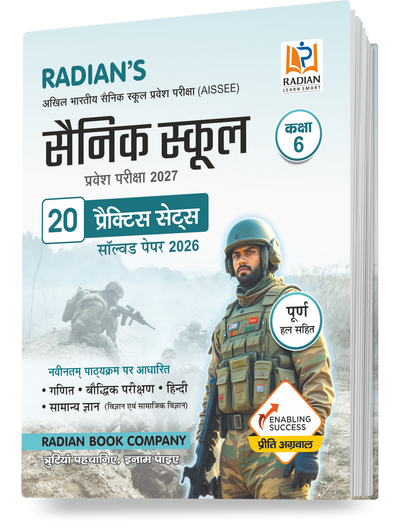
Sainik School Class 6 Book 2027: 20 Practice Sets Hindi
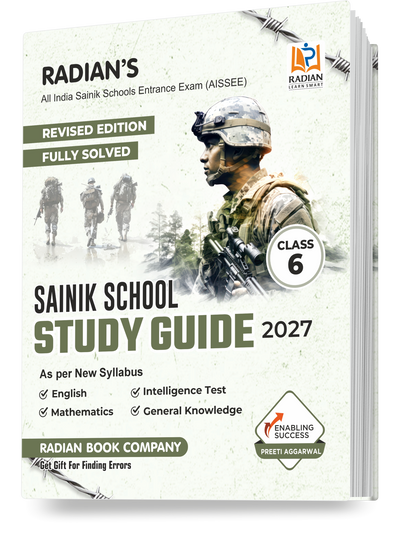
Sainik School Class 6 Guide 2027 English | AISSEE Complete Study Material PYQ's & MCQs
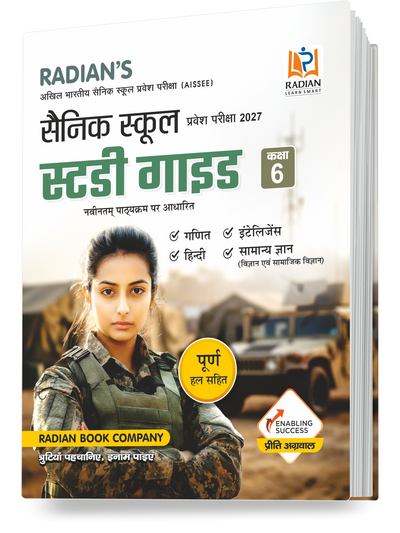
Sainik School Class 6 Guide 2027 Hindi | AISSEE Complete Study Material PYQ's & MCQs